
Infrared & Detox: What Couples Trying to Conceive Need to Know
A research-backed look at how environmental toxins silently threaten fertility — and how infrared therapy may help clear the path to parenthood.
For many couples trying to conceive, the conversation around fertility focuses on hormones, timing, and lifestyle. But there is a quieter, less-discussed threat lurking in our food, water, air, and everyday products: heavy metals and environmental toxins. Research now strongly links these substances to reduced egg quality, lower sperm counts, miscarriage, and failed IVF cycles. Encouragingly, emerging science also points to infrared technology — both as a sauna-based detox tool and as a direct phototherapy for reproductive cells — as a meaningful part of the solution.
01 — The Hidden Fertility Crisis: Toxins in Our Bodies
The world is facing a slow-motion fertility crisis. Over the past 60 years, the number of children born per woman has dropped by roughly 50%. While some of this is by choice, researchers estimate that 1 in 7 to 1 in 10 couples in North America now face serious difficulty conceiving — and a growing body of evidence points to environmental toxins as a major contributing factor.[1]
We are exposed to these substances constantly: through the food we eat, the water we drink, the air we breathe, and even the personal care products we apply to our skin. Unlike many organic pollutants that the body can metabolise and break down, heavy metals persist. They accumulate in tissues over months and even decades, gradually building up a burden that can silently undermine reproductive health long before any symptoms appear.[2]
Key statistic: A landmark study found that approximately 90% of the general population has detectable levels of pesticides in blood and urine samples — a finding that underscores just how pervasive environmental contamination has become.[3]
Endocrine-disrupting chemicals (EDCs) — a broad category that includes heavy metals, phthalates, BPA, pesticides, and industrial compounds — interfere with the hormonal signals that govern the entire reproductive cycle: from ovulation and follicle development to sperm production and embryo implantation. The result is a cascade of subtle but compounding damage to fertility at the cellular level.[4]
02 — The Key Heavy Metals Damaging Reproduction
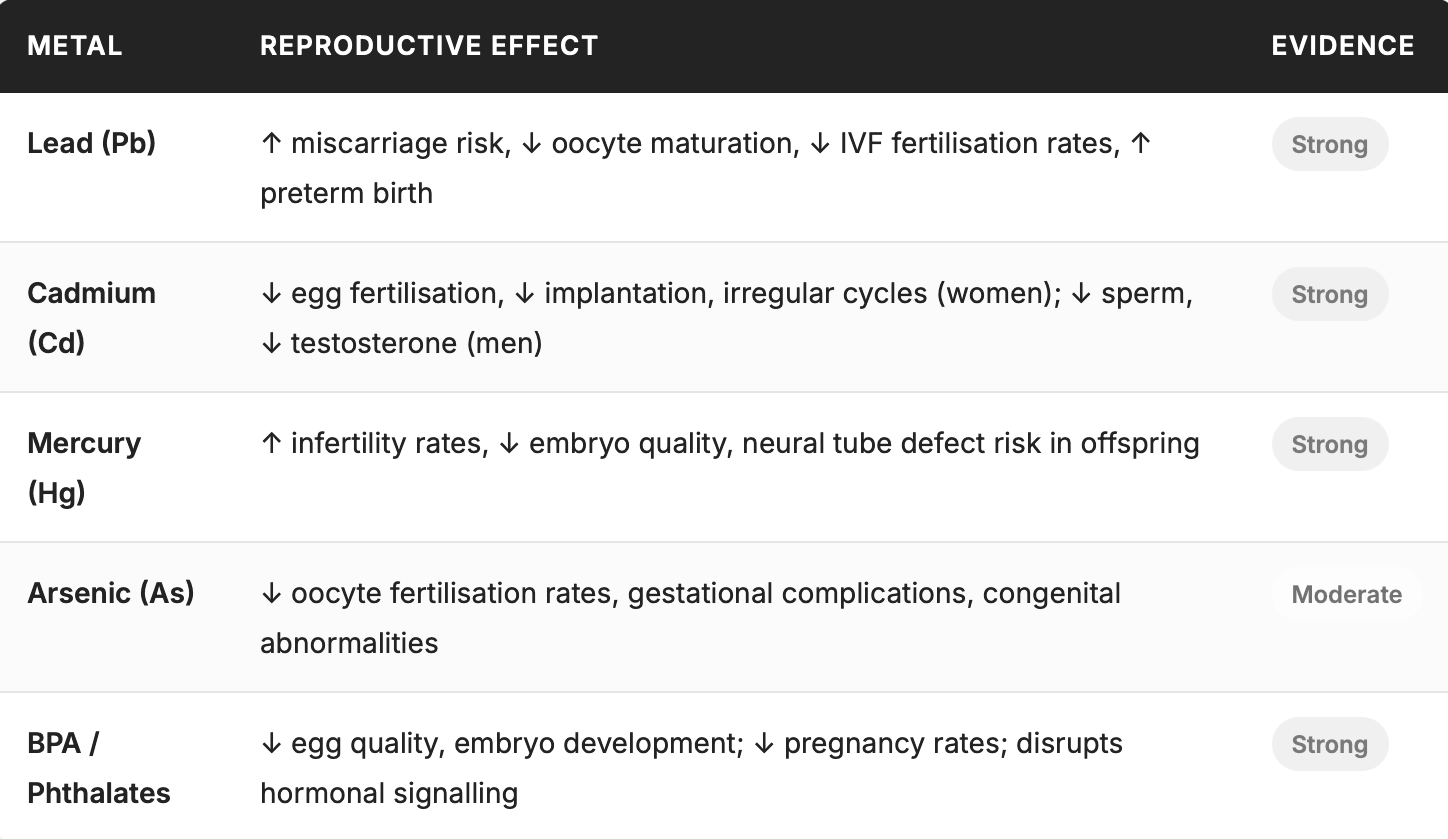
Not all heavy metals are equal in their reproductive harm. Research consistently highlights four metals as the most clinically significant for couples trying to conceive:
Lead
PB · SOURCES: OLD PAINT, PIPES, IMPORTED POTTERY, SOME TRADITIONAL REMEDIES
A potent neurotoxin linked to spontaneous abortion, preterm delivery, and impaired egg maturation. Even low blood levels — well within ranges once considered "safe" — negatively affect IVF fertilisation outcomes.[5]
Cadmium
CD · SOURCES: TOBACCO SMOKE, BATTERIES, PESTICIDES, LEAFY VEGETABLES GROWN IN CONTAMINATED SOIL
Accumulates in the ovaries and testes. Linked to decreased oocyte fertilisation and embryo implantation rates, irregular menstrual cycles in women, and reduced sperm quality and testosterone in men.[6]
Mercury
HG · SOURCES: CERTAIN FISH (SWORDFISH, SHARK, TUNA), DENTAL AMALGAMS, INDUSTRIAL POLLUTION
Studies in Hong Kong found infertile couples had significantly higher blood mercury levels than fertile controls. Mercury has also been linked to poor embryo quality and neural tube defects in offspring.[7]
Arsenic
AS · SOURCES: CONTAMINATED GROUNDWATER, RICE, SEAFOOD, INDUSTRIAL AREAS
Found at measurable levels in follicular fluid and seminal plasma. Correlated negatively with oocyte fertilisation rates. Arsenic exposure is also associated with gestational complications and congenital abnormalities.[8]
Beyond these four, other substances of concern include BPA (plastics, food can liners), phthalates(cosmetics, plastics), PCBs, flame retardants, and organochlorine pesticides — all of which have been detected in blood, follicular fluid, and seminal plasma of individuals undergoing fertility treatment.[9]
03 — How Toxins Sabotage Eggs, Sperm & IVF Outcomes
The mechanisms by which heavy metals harm fertility are well-documented. Heavy metals interact with the sulfhydryl enzyme groups in the body's antioxidant systems, essentially deactivating the enzymes needed for cellular energy production. This disruption affects virtually every stage of reproduction.[10]
In Women
Heavy metals have been shown to cause hormonal imbalance, follicular atresia (premature destruction of follicles), and delayed oocyte maturation. Elevated lead levels are associated with a dose-dependent increase in spontaneous abortion risk — with blood lead levels above 40 µg/L linked to an odds ratio of over 22 for miscarriage.[11]
In women with high cadmium levels, IVF studies consistently find significantly reduced fertilisation rates and lower rates of successful embryo implantation. Lead has also been shown to cause epigenetic changes — altering DNA methylation in ways that affect the structural integrity of the uterine cervix and chorio-amniotic membranes.[12]
Research finding (Frontiers in Reproductive Health, 2022): A systematic review of 30 studies confirmed that heavy metals and metalloids — including Pb, Hg, Cd, Cr, Mn, and As — correlated negatively with oocyte fertilisation and pregnancy rates. High metal concentrations were also associated with PCOS, endometriosis, uterine fibroids, and higher rates of miscarriage. The authors concluded that couples undergoing IVF should be routinely screened for heavy metal burden.[13]
In Men
The global decline in male fertility is stark: research documents a 50% reduction in sperm quality over the last 40 years.[14] Heavy metal exposure is increasingly implicated in this trend. Lead decreases sperm motility. Cadmium reduces sperm quality, motility, and testosterone levels. In a large US study of 501 infertile couples, blood cadmium levels in women and blood lead levels in men were each independently associated with reduced fertility outcomes.[15]
Impact on IVF
Even at low, non-occupational exposure levels, heavy metals measurably reduce IVF success rates. Couples living in areas with higher environmental contaminant levels consistently show worse IVF outcomes compared to those in lower-exposure areas.[13] Environmental contamination may, in fact, be contributing to the high dropout rate from IVF programmes — a pattern often attributed to emotional burden, but potentially compounded by unrecognised toxic load.
04 — Infrared Sauna: A Sweat-Based Detox Strategy
Sweat has long been understood as one of the body's natural elimination pathways — alongside the liver, kidneys, and digestive system. But recent research has clarified just how significant sweating can be for removing heavy metals and industrial toxins that other systems struggle to excrete.
This is where infrared sauna therapy enters the picture. Unlike conventional saunas that heat the surrounding air to very high temperatures (180–200°F), far infrared saunas use radiant energy that penetrates directly into body tissues, raising core temperature at much lower ambient temperatures (typically 120–150°F). This deeper thermal penetration appears to mobilise toxins stored in fat tissue and other organs more effectively than surface heating alone.[16]
The BUS Study — Blood, Urine & Sweat
The landmark research on this topic comes from Dr. Stephen Genuis and colleagues at the University of Alberta, who conducted a series of studies analysing blood, urine, and sweat for approximately 120 substances. Their key findings were striking:
BUS Study findings: Toxic elements were found in measurable concentrations in all three fluids — but sweat consistently outperformed blood and urine as an excretion pathway for many heavy metals. Notably, some participants had no detectable cadmium in blood or urine, yet showed significant cadmium levels in their sweat. The researchers concluded that induced sweating appears to be a viable method for eliminating many toxic elements from the human body — and that blood and urine testing alone may underestimate total body burden.[17]
What Infrared Sauna Can Help Excrete
Subsequent studies by the same group extended these findings across multiple categories of harmful compounds:
Heavy metals: Cadmium, lead, mercury, arsenic, nickel, aluminium, chromium[17, 18]
Phthalates (found at 2x higher concentration in sweat than urine)[19]
BPA (detected in sweat of 14/20 participants with no detectable blood levels)[17]
Flame retardants (PBDEs)[20]
Organochlorine pesticides (DDT, DDE, endosulfan — at levels exceeding urinary excretion)[21]
PCBs (polychlorinated biphenyls)[22]
A 2023 study published in Environmental Science and Pollution Research analysed sweat from 22 participants using a water-filtered infrared-A (wIRA) sauna. Sweat concentrations of mercury were 34.8 times higher, arsenic 18 times higher, lead 6.8–496 times higher, and cadmium 4.2–418 times higher than in other studies using conventional methods — suggesting that infrared saunas may achieve particularly effective mobilisation of stored toxins.[23]
Important caveat — replenish nutrients: Alongside toxic elements, sauna sweating also excretes beneficial minerals. Research specifically identifies that selenium and vanadium are excreted simultaneously with cadmium, arsenic, and other toxins. Supplementing with zinc and selenium during any sauna detox protocol is recommended.[23]
Infrared vs. Traditional Sauna: Does It Matter?
Both infrared and conventional saunas produce measurable toxin excretion in sweat. However, the BUS researchers specifically noted that infrared sauna use produced better results for bismuth, cadmium, chromium, mercury, and uranium elimination compared to steam sauna or exercise alone. The deeper tissue penetration of infrared energy — approximately 1.5 inches into the body — appears to reach fat-stored toxins that surface heating cannot access.[16]
05 — Red & Near-Infrared Light Therapy for Reproductive Cells
Distinct from sauna-based detox, photobiomodulation (PBM) — the application of red (620–700 nm) and near-infrared (700–1100 nm) light directly to body tissues — is emerging as a genuinely exciting frontier in reproductive medicine. Rather than working through heat-induced sweating, PBM works at the cellular level by stimulating the mitochondria.
Mitochondria are the energy-producing organelles in every cell, and they are uniquely sensitive to red and near-infrared light. When exposed to these wavelengths, mitochondria produce more ATP (cellular energy), reduce oxidative stress, and improve overall cellular function. This matters enormously for fertility, because egg quality, sperm motility, and embryo development are all highly energy-dependent processes.[24]
2024 Clinical Study (Journal of Clinical Medicine): A prospective case series published in November 2024 evaluated multiwavelength red and NIR laser photobiomodulation in women with unexplained infertility — including those who had failed IVF cycles, experienced multiple miscarriages, or had non-viable embryos. In every single case, fertility outcomes improved.The study concluded that PBM with LED or laser — or a combination of both — contributed to healthy live births in women diagnosed with unexplained age-related infertility.[25]
For Women: Ovarian Rejuvenation
As women age, mitochondrial energy production in their eggs declines — a key driver of reduced ovarian reserve and egg quality. PBM applied to the abdominal region has been explored as a way to counter this decline by re-energising oocyte mitochondria. Researchers are investigating improvements in ovarian reserve markers, egg maturation rates, and embryo viability following PBM protocols.[24, 25]
For Men: Sperm Function
A study on sperm exposed to photobiomodulation found that most visible and near-infrared wavelengths significantly increased sperm energy production without causing cellular damage. The data suggests light therapy applied with appropriate parameters may offer a promising, non-invasive approach to improving sperm function in men with fertility challenges.[26] Notably, wavelength selection matters: light at 635 nm was found to reduce energy production, while other wavelengths in the NIR range showed benefit — underlining the importance of using medically validated protocols.
Combined Approach: Detox + Direct Therapy
There is a compelling logic in combining these two modalities: use infrared sauna to reduce the underlying toxic burden damaging reproductive cells, while using targeted red/NIR photobiomodulation to directly support the cellular energy systems of eggs and sperm. The two approaches address fertility from different angles and may be synergistic.
06 — A Practical Protocol for Couples Trying to Conceive
Based on the available research, here is a reasonable, evidence-informed framework. This should be discussed with and supervised by a healthcare provider before starting.
Step 1 — Test First
Before beginning any detox protocol, consider comprehensive testing. Research suggests that blood and urine alone may underestimate toxic burden, and that sweat testing can reveal metals not detected in blood or urine.[17] Ask your doctor about testing for lead, cadmium, mercury, and arsenic — ideally in combination with hormone and fertility markers.
Step 2 — Reduce Ongoing Exposure
No detox protocol will be effective if exposure continues unchecked. Key dietary adjustments include limiting high-mercury fish (shark, swordfish, king mackerel, bigeye tuna) and opting for lower-mercury options (salmon, shrimp, sardines). Replace plastic food containers with glass or stainless steel, and avoid reheating food in plastic. Prioritise organic produce where possible, particularly for the "dirty dozen" high-pesticide crops.[3]
Step 3 — Infrared Sauna Protocol
Clinical settings using sauna for detox typically recommend 2–3 sessions per week, starting with shorter 15–20 minute sessions and building up as tolerance develops. Always hydrate well before, during, and after sessions. Because sweating also depletes beneficial minerals, ensure adequate intake of selenium, zinc, magnesium, and vitamin C throughout the protocol. Avoid sauna use if pregnancy is confirmed or suspected.[16, 23]
Step 4 — Red/NIR Light Therapy
Photobiomodulation for fertility is best administered by a practitioner experienced in the field, as wavelength, dosimetry, and treatment location all affect outcomes. Clinical protocols typically apply light to the lower abdomen (for ovarian support) or directly to sperm samples (for male fertility enhancement). At-home devices exist but vary widely in quality and clinical relevance; look for devices with peer-reviewed validation.[25]
Step 5 — Support Cellular Health
Infrared therapy works best as part of a broader cellular health strategy. Mitochondrial support nutrients — CoQ10, alpha-lipoic acid, NAC, and antioxidants — complement both the detox and photobiomodulation components of a fertility protocol. These nutrients have independent evidence for supporting egg quality and sperm function.
07 — Cautions & Limitations
Infrared sauna is contraindicated during pregnancy. Elevated core body temperature in early pregnancy carries risks of neural tube defects and other complications. Sauna-based detox should be completed before attempting conception — not during a cycle where conception is possible. Always confirm pregnancy status before any session.[16]
Evidence quality: The science linking heavy metals to infertility is well-established across many peer-reviewed studies. The evidence for infrared sauna as a detox tool is supportive but based largely on smaller studies. Red/NIR photobiomodulation for fertility is genuinely promising, but requires larger controlled trials to establish standardised dosimetry and protocols. These therapies should complement — not replace — conventional medical evaluation and treatment.
Other contraindications might not be mentioned here for specific cases. Always consult your physician before beginning any new therapeutic protocol, particularly when trying to conceive.
The Bigger Picture
Fertility is not just a matter of timing. For a growing number of couples, there is an invisible biological burden — accumulated years of environmental exposure — quietly working against conception. The good news is that the body has pathways for eliminating these toxins, and emerging therapies like infrared sauna and photobiomodulation offer promising, non-invasive ways to support those pathways and directly nourish reproductive cells.
None of this replaces expert medical care. But for couples committed to optimising every dimension of their fertility journey, understanding the role of environmental toxins — and the tools that may help address them — could be a genuinely meaningful piece of the puzzle.
References & Sources
[1]Pizzorno J. Environmental Toxins and Infertility. Integrative Medicine: A Clinician's Journal. PMC6396757. View on PubMed Central →
[2]Sears ME, Kerr KJ, Bray RI. Arsenic, cadmium, lead, and mercury in sweat: a systematic review. J Environ Public Health. 2012;2012:184745. PMID: 22505948.
[3]Nazni P, et al. Environmental Toxins and Infertility. StatPearls, NCBI Bookshelf. Updated 2025. View →
[4]MIOG Australia. Infrared Saunas: A Modern Solution for Detox and Relaxation. View →
[5]Al-Saleh I, et al. Exposure to heavy metals (lead, cadmium and mercury) and its effect on the outcome of in-vitro fertilization treatment. PubMed. PMID: 18160343. View →
[6]Fertility Center Online. How environmental toxin exposure impacts fertility. View →
[7]Pizzorno J. Environmental Toxins and Infertility — mercury data from Hong Kong study. PMC6396757.
[8]Obasi CN, et al. Heavy metals and metalloids exposure and in vitro fertilization: Critical concerns in human reproductive medicine. Frontiers in Reproductive Health. 2022. View →
[9]Younglai EV, et al. Levels of environmental contaminants in human follicular fluid, serum, and seminal plasma of couples undergoing IVF. Arch Environ Contam Toxicol. 2002;43(1):121–6. PMID: 12045882.
[10]Obasi CN et al. Frontiers in Reproductive Health. 2022 (mechanism of SH enzyme group interaction).
[11]Blood lead level and miscarriage odds ratios. Cited in: Obasi CN et al., Frontiers in Reproductive Health, 2022.
[12]Obasi CN et al. Epigenetic changes and COL1A2 methylation with Pb exposure in IVF patients. Frontiers in Reproductive Health. 2022.
[13]Obasi CN, et al. Heavy metals and metalloids exposure and IVF: Critical concerns. Frontiers in Reproductive Health. 2022. doi: 10.3389/frph.2022.1037379
[14]Levine H, et al. (cited in): Efficacy and Safety of Visible and Near-Infrared Photobiomodulation on Asthenospermic Human Sperm. PMC12109510. View →
[15]Pizzorno J. Environmental Toxins and Infertility. PMC6396757 — US study of 501 infertile couples (cadmium/lead data).
[16]Haven of Heat / Clearlight Infrared Saunas. What Toxins Do You Actually Sweat Out in a Sauna? View →
[17]Genuis SJ, Birkholz D, Rodushkin I, Beesoon S. Blood, urine, and sweat (BUS) study: monitoring and elimination of bioaccumulated toxic elements. Arch Environ Contam Toxicol.2011;61(2):344–357. PMID: 21057782.
[18]Sears ME, Kerr KJ, Bray RI. Arsenic, cadmium, lead, and mercury in sweat: a systematic review. J Environ Public Health. 2012;2012:184745.
[19]Genuis SJ, Beesoon S, Lobo RA, et al. Human elimination of phthalate compounds: blood, urine, and sweat (BUS) study. TheScientificWorldJournal. 2012;2012:615068.
[20]Genuis SK, Birkholz D, Genuis SJ. Human Excretion of Polybrominated Diphenyl Ether Flame Retardants: Blood, Urine, and Sweat Study. BioMed Research International. 2017;2017:3676089.
[21]Pesticide excretion via sweat — cited in: Clinical Effects of Regular Dry Sauna Bathing (2018 systematic review).
[22]Genuis SJ, Beesoon S, Birkholz D. Biomonitoring and Elimination of Perfluorinated Compounds and PCBs through Perspiration. ISRN Toxicology. 2013;2013:483832.
[23]Cho K, et al. Effect of water filtration infrared-A (wIRA) sauna on inorganic ions excreted through sweat from the human body. Environ Sci Pollut Res. 2023;30:18260–18267. View →
[24]ASAP IVs. Can Red Light Therapy Help Boost My Fertility? View →
[25]Phypers R, Berisha-Muharremi V, Hanna R. The Efficacy of Multiwavelength Red and NIR Transdermal Photobiomodulation Light Therapy in Enhancing Female Fertility Outcomes. J Clin Med. 2024;13(23):7101. doi:10.3390/jcm13237101. View on PubMed →
[26]Efficacy and Safety of Visible and Near-Infrared Photobiomodulation Therapy on Asthenospermic Human Sperm. PMC12109510. 2025. View →
